
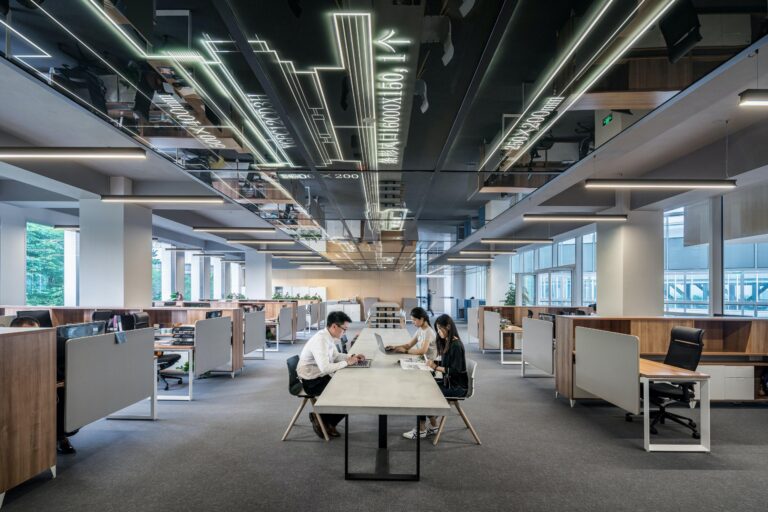
I Have 100 Staff — Where Do I Start with My Office Furniture Fitout?

Get Pricing
Sit-stand desks, lockers, workstations and seating — indicative pricing for commercial fitouts in Canberra.
Pricing Catalogue
A step-by-step starting point for planning a 100-person office fitout — from space calculations to installation day.
For 100 employees, plan for 1,000–2,000 m² depending on layout, with 1,200–1,500 m² typical for a modern open-plan office with breakout and meeting spaces. Safe Work Australia’s minimum is 10 m² per person, and hybrid working can reduce this by 20–30%.
Jump Ahead
You’ve just been handed a 100-person fitout, and you don’t know where to start. That’s a normal place to be — most operations managers, facilities managers and office managers running a fitout at this scale are doing it for the first time.
The stakes are different from a 10 or 20-person office refresh. Get it wrong here and you’re not just reordering a few office chairs — you’re looking at blown timelines, wasted spend, and a workspace that doesn’t actually work for the people using it.
We asked our office furniture experts and put together a guide that walks you through how much space you actually need, the decisions that shape everything before you order a single desk, and what a properly run fitout process looks like from first contact to install day.
What’s the Minimum Office Space Per Person in Australia?
In Australia, Safe Work Australia and the Property Council of Australia recommend a minimum of 10 m² per employee. This includes not just desks, but circulation and common areas.
For 100 staff, that equals a minimum of 1,000 m².
This figure assumes a very basic, open-plan setup with no private offices, limited meeting rooms, and no breakout zones. It meets compliance but may not support productivity.
Ideal Office Space Requirements by Workspace Type
Depending on your layout and work model, your actual space needs may vary:
| Office Layout | Area per person | Total for 100 people |
|---|---|---|
| Open-plan only (desks and aisles) | 10–12 m² | 1,000–1,200 m² |
| Open-plan with collaboration and storage | 12–15 m² | 1,200–1,500 m² |
| Hybrid (hotdesking with breakout areas) | 8–10 m² | 800–1,000 m² |
| Traditional (private offices and meeting rooms) | 15–20 m² | 1,500–2,000 m² |
Sample Office Layout for 100 Staff (1,200 m²)
If you’re aiming for a functional, modern workplace, here’s a sample breakdown Aurora might recommend:
| Space Type | Area | Notes |
|---|---|---|
| 80 Workstations | 500 m² | 6–8 m² per desk including aisles |
| 20 Hot desks or flex-use | 80 m² | For casual or rotating staff |
| 4 Meeting rooms | 100 m² | Mix of 4-person, 6-person, and 12-person rooms |
| 2 Quiet rooms | 20 m² | For calls or focused work |
| Kitchen and breakout | 150 m² | Communal eating and recharge area |
| Reception | 50 m² | Optional front-of-house space |
| Storage, lockers, print | 100 m² | Includes utility zones |
| Bathrooms | 100 m² | As per building code |
| Circulation areas | 100 m² | Includes aisles and accessways |
Total: approximately 1,200 m²
The Five Questions To Answer Before You Order Anything
Before square metres, desk counts or supplier quotes, there are decisions that shape the whole fitout. Get these wrong early and you’ll either be redesigning later, or living with a workspace that doesn’t fit how your people actually work.
1. How Do Your Staff Do Their Best Work?
How do your people actually work…not how you assume they work. This starts with a proper briefing, not a guess: current furniture preferences, how collaborative vs. individual the work actually is, and what staff have said isn’t working in the space they’re in now. Reception, locker rooms and breakout areas each get their own consideration here too — they’re not an afterthought once desks are sorted, they’re part of the same briefing.
2. Team Size vs. Seating Ratio
Are all 100 employees in the office daily, or do you operate a hybrid model? Hot-desking and staggered attendance can reduce your space needs by 20 to 30 percent. The answer to this question changes how many desks, meeting rooms and lockers you actually need. Miss this and you either overbuild and pay for space you don’t use, or underbuild and run out of desks on your busiest days.
3. How Does Your Workspace Need To Function?
Open-plan supports collaboration, but 100 people in one open space creates real audio and visual distraction. Quiet zones and booths need to be planned in from the start — not added as an afterthought once the open-plan layout is locked in.
This isn’t a nice-to-have. Peer-reviewed research has found that exposure to colleagues’ conversations in open-plan offices can cut productivity on focus tasks by up to two-thirds. At 15 desks that’s manageable. At 100, without quiet zones and booths planned in from the start, it’s a measurable productivity cost.
Do you need client-facing zones, showrooms, warehouse access, or dedicated collaboration areas? These will increase your total commercial office layout footprint.
4. What Are Your Growth Plans?
Plan against where the business will realistically be by the end of your lease, not just the number on today’s org chart. A layout that fits 100 people perfectly on day one can become a costly problem in year three if growth wasn’t built in.
5. What Amenities Does Your Workspace Need?
Lockers, storage and breakout facilities need to be sized to actual staff numbers and available space — not bolted on as an afterthought once desks are sorted.
How your people actually work
Look at how much is collaborative vs. individual focus work, and what staff say isn’t working in the current space, before any layout decision.
Your hybrid ratio
Real daily occupancy is lower than headcount if staff work from home. Get this wrong and you overbuild or run out of desks.
Where quiet, focus-driven work happens
100 people in one open space creates real distraction. Quiet zones and booths need to be planned in from the start.
Your growth horizon
Plan against where the business will be by the end of your lease, not just today’s headcount.
How lockers and storage scale
Lockers, storage and amenity space need to be sized to actual staff numbers — not bolted on once desks are sorted.
Where Can 100-Person Office Fitouts Go Wrong?
Offices with 10 to 20 people often handle furniture and setup internally, and get away with it. At 100-person scale, the same DIY approach is where things start to go wrong.
Cheap chairs and bad screens cause backaches and reduce focus. Poor cable management creates distractions and makes the office look unprofessional. High audio and visual distraction reduces staff concentration throughout the day — and it’s a problem that compounds fast once you’re planning for 100 people instead of 15.
— Dean Grace, Managing Director at Aurora Office Furniture
The other major failure point isn’t the furniture itself — it’s coordination. That’s covered below.
1. You’re Not Following A Proper Fitout Process
A 100-person fitout run properly moves through 6 stages:
1. Client briefing. Detailed discovery on your goals, how your people currently work, and what’s and isn’t working in your existing space — captured up front so the quote reflects everything you actually need, not just a desk count.
2. Layout planning. Draft layouts are revised as many times as needed, with open-plan, meeting rooms, breakout areas, reception and locker rooms each treated as their own design problem, not an afterthought.
3. Lead time management. Your move-out date, new space readiness, and any other trades needing access to the site set the real project window — accounted for early to avoid scheduling conflicts and costly delays.
4. Design and electrical sign-off. Once the layout is finalised, the electrical plan is presented and approved before anything is booked into the installation schedule.
5. Installation day. Furniture is delivered, stacked and floor-loaded, then set up and laid out — with rubbish removal and site cleanup handled as part of the job, not an extra.
6. Client liaison throughout. Ongoing communication and on-site adjustments where needed, so there are no surprises and the transition into the new space is seamless.
2. Installation Doesn’t Go To Plan
The biggest delays happen when people just order boxes of flat-pack furniture and forget installation. That’s where costs and timeframes blow out.
— Dean Grace, CEO, Aurora Office Furniture
At 100-person scale, installation problems are usually a supply chain and coordination failure, not a furniture failure.
The pattern we see:
- Resource allocation that’s too thin for the job with no backup plan if something slips
- Furniture that doesn’t arrive on site as scheduled and blocks installers
- Installer attendance that isn’t reliable — all made worse when site teams aren’t told about delays or changes as they happen. Without that communication, nobody can solve the problem before the deadline slips.
Aurora Office Furniture manages installation, delivery and site cleanup under one roof specifically to remove this failure point — your team walks into a fully operational workspace with no loose ends and no coordination left for you to chase.

3. Ignoring The Reality of Hybrid Work and Space Planning
Recognising that a share of your 100 staff work from home on any given day lowers your real daily occupancy — which means smaller, more efficient office footprints and lower real estate cost, without cutting the space your team actually needs when they’re in.
This is also where long-term planning pays off: designing from a lease-end perspective, rather than today’s headcount, means the layout still works as the business grows instead of forcing an early, costly move.
4. Plan From Lease End, Not Day One
Most of the fitout mistakes we see at 100-person scale trace back to one thing: the business planned for today’s headcount instead of where it’ll be by the end of the lease. Design from a 5–10 year horizon, working backwards from what the office needs to look like when the lease ends, not just what fits now. Get this wrong and you’re looking at an expensive early relocation or a scramble to add desks and meeting rooms into a space that was never built to flex.
This is also where hybrid work changes the maths. Most organisations now plan around an 80% on-site utilisation rate rather than assuming every employee is in the office every day — which is exactly why the sample 1,200 m² layout above uses 100 workstations/hot-desk combined rather than 100 fixed desks. Overprovision for headcount that’s rarely fully in the building and you’re paying rent on empty desks; underprovision and you run out of space on your busiest days.
It’s worth noting the public sector has learned this the hard way at scale: the Australian Government’s own office-space target was 16 m² per occupied work point in 2009, revised down to 14 m² by 2013 — and only 13% of tenancies had actually hit that tighter target within a year of it changing. Density targets are easy to set and hard to retrofit into a space that wasn’t designed to flex. Planning it in from day one is far cheaper than re-fitting it in year three.
Aurora Office Furniture’s Office Fitout Advice for 100 Staff
If you’re planning office space for 100 employees, here’s how we can help:
1. Start with a 3D Floor Plan
Send us your building layout and we’ll create a fast 3D drawing so you can visualise your commercial office layout and move quickly to decision-making.
2. Deadline-Driven Fitouts
We ask for your install deadline and reverse-engineer a plan to meet it. If needed, we can store your furniture until your site is ready.
3. In-Stock Products, Delivered Fast
We stock desks, chairs, mobile drawers, screens, and more. These are ready to deliver and install within one week in Sydney, Melbourne, Canberra, and across Australia.
4. Full Service Installation
Unlike flat-pack providers, Aurora includes office furniture installation, rubbish removal, and aftercare support. Your team walks into a fully operational workspace with no loose ends.

Our End-to-End Service Covers Everything
We manage the full process from start to finish, including:
- Office furniture installation
- 3D plans and custom layouts
- Rubbish removal and site cleanup
- After-sales support and warranty
- Furniture storage until your deadline
Frequently Asked Questions (FAQs)
How much space per person is legally required in Australia?
At least 10 m² per person, including circulation. However, 12 to 15 m² is recommended for comfort and productivity.
Can I reduce space with hybrid working?
Yes. Hotdesking or part-time attendance can reduce total required space to 800 to 1,000 m² for 100 staff.
Do I need breakout spaces?
Yes. Breakout zones help support collaboration, reduce noise, and improve employee wellbeing.
How fast can you deliver for a 100-person office?
Aurora can deliver and install within one week using our in-stock product ranges and efficient scheduling process.
Do you offer 3D layout plans?
Yes. We provide tailored CAD and 3D layout plans to help you visualise the space and move forward with confidence.
What’s the difference in space needs between open-plan and hybrid/activity-based working?
Open-plan without hybrid planning generally needs 10–12 m² per person. Factor in hybrid attendance and an activity-based mix of desks, hot desks and quiet zones, and that can drop to 8–10 m² per person for the same headcount.

Ready to Plan Your Fitout?
Plan Your Office for 100 Staff. Get expert layouts, fast delivery, and complete support from one of Australia’s top office furniture installation companies.
Office Space Planning Guide: How to Fit Out for 100 Staff
Need help planning your office layout?
Download our free guide packed with practical insights, floorplan samples, and expert tips tailored for teams of 100. Learn how much space you really need, explore different layout styles, and avoid the most common fitout mistakes.
Perfect for HR, Operations, and Office Managers in Sydney, Melbourne, Canberra, and across Australia.
• Minimum and ideal space per employee
• Sample 1,200 m² floor plan for 100 staff
• Tips for hybrid work setups
• Installation checklist and deadlines
• Bonus: Fitout timeline and budgeting tips
Lead Magnet Download Form
Featured posts
View all posts


Get Our Pricing Catalogue
