


12 Tips When Buying Staff Lockers for Australian Commercial Offices

Get Pricing
Sit-stand desks, lockers, workstations and seating — indicative pricing for commercial fitouts in Canberra.
Pricing Catalogue
Aurora’s team walks facilities managers and procurement officers through the decisions that matter before you sign off on a locker order.
Quick answer
The most important locker decision isn’t material or price — it’s the locking system. Choosing the wrong lock type creates ongoing administration headaches that compound with every staff change, lost key and forgotten code. Get lock administration right first, then specify everything else around it.
Aurora has supplied commercial lockers to government, education and corporate environments across Australia for 20+ years. These 12 tips reflect what consistently goes wrong — and what the buyers who get it right do differently.
Buying staff lockers for a commercial office looks straightforward until it isn’t. The product decision is the easy part. The decisions that cause problems — wrong locking system, insufficient storage capacity, no plan for staff turnover, accessories that weren’t considered until after installation — are the ones that create ongoing headaches for facilities managers long after the lockers arrive.
Aurora has supplied lockers to government departments, corporate offices, education facilities and commercial clients across Australia for more than 20 years. These 12 tips are drawn directly from what our team sees go wrong — and what the buyers who get it right do differently.
Ready to start budgeting for your staff locker fitout?
12 tips at a glance
Start with the users, not the product
Decide assigned vs shared before everything else
Plan lock administration before choosing lock type
Default to code lock with master override for shared offices
Think about staff turnover before you sign off
Size to what staff actually store, not what you assume
Measure your space before specifying configuration
Specify accessories at the same time — not after
Understand compliance requirements before specifying
Choose material for the environment, not the budget
Scale your process — but don’t skip the steps
Get a specification, not just a quote
1. Start with the users, not the product
Every successful locker project starts the same way: with a clear picture of who the lockers are for and how they’ll be used. Are lockers assigned to permanent staff members, or shared between multiple users on rotation? Are they for an open-plan corporate floor, a government secure zone, a school administration area, or an end-of-trip facility?
The answers to these questions determine material, configuration, size and locking system. Skipping this step and going straight to product selection is how organisations end up with lockers that look right but create friction every day.
2. Decide assigned vs shared before everything else
This single decision has the largest downstream effect on specification. Assigned lockers — where each unit belongs to one staff member — suit stable workforces and call for locking systems that prioritise security and personal ownership. Shared lockers — used by different people throughout the day or week — require locking systems that are fast to reset, easy to administer and low-friction for users who may not be familiar with them.
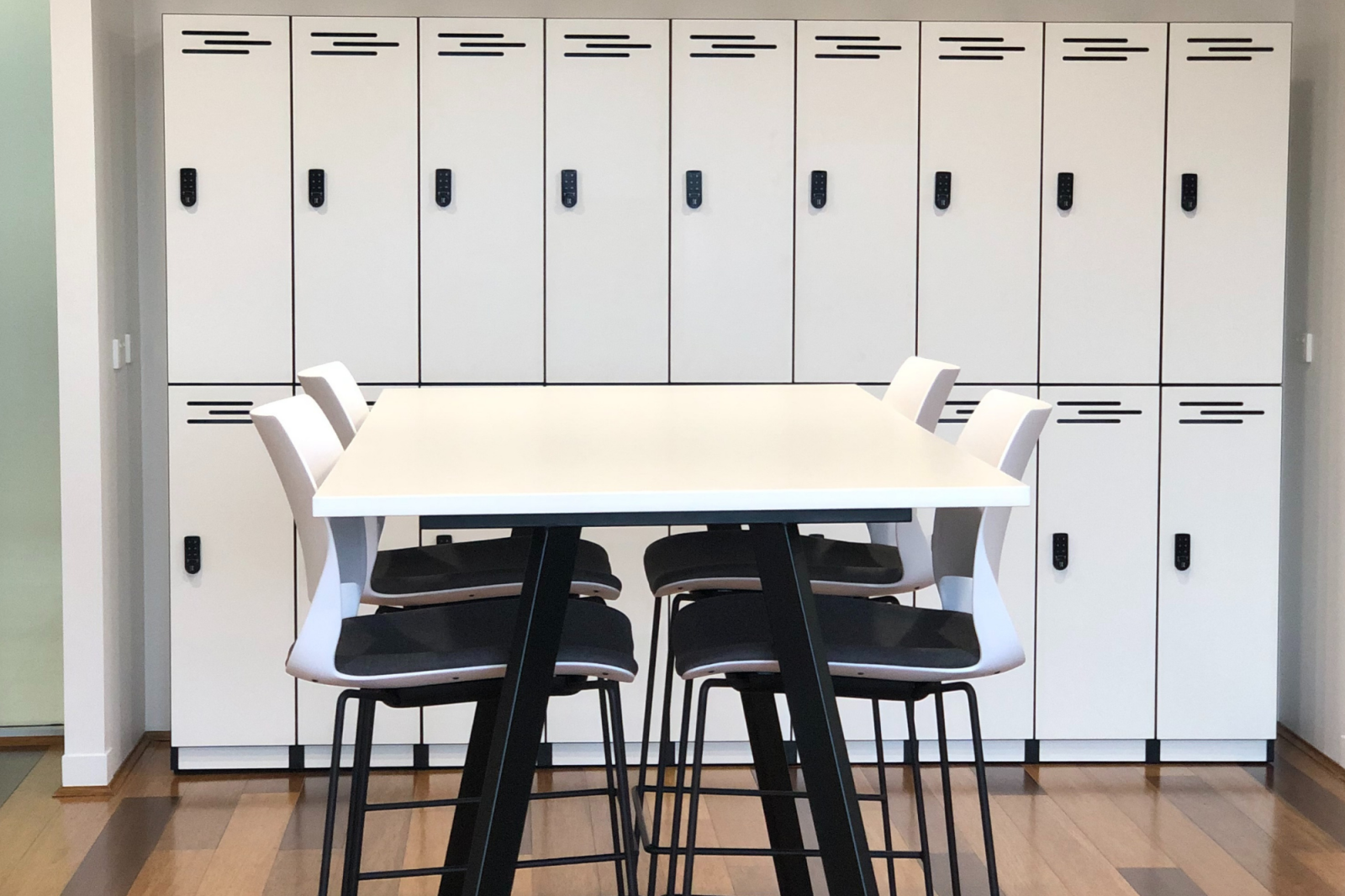
Getting this wrong means the locking system and the usage pattern are mismatched from day one. A key lock on a shared locker bank creates a lost-key management problem at scale. A coin-operated system on a permanently assigned locker is an unnecessary daily irritation.
3. Plan lock administration before you choose a lock type
Lock type is one of the most debated decisions in locker procurement and one of the most commonly approached in the wrong order. Most buyers pick a lock based on how it looks or what they’ve seen before — then discover the administrative implications after installation.
The right order is: understand how the locking system will be administered, then choose a lock type that fits that operational reality.
The questions that should come first:
- Who is responsible for managing access — facilities team, HR, or users themselves?
- What happens when a staff member leaves, forgets their code or loses a key?
- Is there a requirement for an audit trail of who accessed which locker?
- Does the organisation have an existing lock standard or building access system to integrate with?
These questions take minutes to answer and determine the entire lock specification. Skipping them is the single most common source of ongoing administration headaches in locker projects.
“Selecting a lock solution that aligns with the organisation’s operational processes is often the single most important decision in a successful locker project.”
Dean, Managing Director at Aurora Office Furniture — 30+ years of commercial locker installations
4. For most shared office environments, start with a manual code lock with master override
Aurora’s default recommendation for shared commercial office environments is a manual code lock with a master key override. This combination provides a strong balance of security, ease of use and simple administration — users set their own code, and facilities managers can access or reset any locker without requiring a locksmith or specialist system.


It suits environments where staff turnover is moderate, locker allocation changes periodically, and the administration burden needs to stay low without sacrificing security. Digital and RFID systems offer more capability — full audit trails, remote access management, integration with building access — but carry higher upfront cost and require ongoing software or system management. The right choice depends on scale, budget and operational complexity.
Lock type comparison — commercial office environments
| Lock type | Best for | Administration | Watch out for |
|---|---|---|---|
| Key lock | Permanently assigned lockers, stable user groups, low-admin environments | Minimal — until a key is lost | Lost key management at scale. Each loss requires a lock change. |
| Code lock ★ Aurora default | Shared offices, hybrid workplaces, moderate staff turnover | Simple — master override for facilities team, user-reset codes | Code sharing possible. Basic models have no audit trail. |
| Digital / RFID | Government, large corporate, high security, frequent staff changes | Full centralised control — remote reset, reassignment, audit trail | Higher upfront cost. Requires ongoing system management. |
| Padlock / hasp | Schools, workshops, environments with existing padlock systems | User-managed — no admin system required | Users supply own padlocks. No master override option. |
| Coin-operated | Gyms, end-of-trip facilities, high-turnover shared use | Fully self-managed — no admin burden | Not suitable for assigned lockers. No security beyond the coin. |
5. Think about staff turnover before you sign off
One of the most consistent problems Aurora sees post-installation is a locking system that wasn’t designed with staff turnover in mind. When a staff member leaves, their locker needs to be cleared, reset and reassigned. When a new person joins, they need access without delay. When someone forgets their code or loses a key, the problem needs to be solved quickly and without disproportionate effort from the facilities team.
What seems like a minor decision at the time of purchase becomes a recurring operational cost if the wrong lock type is chosen. At scale — in a 200-person office, or a government department with regular contractor rotations — this compounds quickly.
Before specifying, ask: how will this locking system be managed in twelve months when staffing has changed? The answer should be straightforward. If it isn’t, the lock type needs to change.
“When organisations choose a locking system without considering staff turnover, lost keys, forgotten codes or changing access requirements, administration can quickly become time-consuming and frustrating.”
Sales Team – Aurora Office Furniture
6. Size lockers to what staff actually store, not what you assume they store
Standard locker dimensions exist for a reason — they suit the most common storage requirements. But ‘standard’ isn’t always right. Before specifying locker dimensions, confirm what your staff will actually be storing day to day.
A locker that can’t fit a laptop bag, a change of clothes and a pair of shoes isn’t doing its job. A locker specified for a gym environment needs to handle helmets, wet gear and bulky workwear. A corporate office locker for a hot-desking floor needs to fit the items staff would otherwise keep at a fixed workstation.
Aurora can specify full-height, half-height, and custom-dimension configurations depending on the application. The cost of getting size wrong is absorbed every day by the people using the lockers — and it creates pressure to modify or replace them well before end of life.
Aurora Office Furniture
Want to know what lockers will cost for your office?
7. Measure your space before specifying configuration
Locker banks need to fit the space they’re going into — including door swing clearance, aisle widths, adjacent fixtures and any building services above or behind the installation zone. A configuration that works on paper can create a congested, non-compliant corridor in reality.
Aurora’s team takes full space measurements as part of the specification process. For larger installations, a 3D layout is produced to confirm the configuration works in practice before any order is placed. For smaller projects, even a basic floor plan review can prevent costly installation-day surprises.
8. Specify accessories at the same time — not after installation
Accessories are among the most commonly overlooked items in a locker specification — and among the most frustrating to add after installation. Shelves, hanging hooks, shoe storage, sloping tops (to prevent items being stored on top of lockers), and adjacent bench seating all need to be considered as part of the initial order.
Sloping tops are particularly worth noting. In environments where lockers are accessible to the public or situated in corridors, flat-top lockers invite items to be stored on top of them — creating visual clutter and potential safety issues. Specifying sloping tops at the outset costs a fraction of what a retrofit or replacement does later.
The same applies to adjacent bench seating. In end-of-trip facilities, changerooms and school corridors, seating is a functional requirement — not an optional extra. Specifying it at the same time as the lockers ensures it integrates with the locker bank rather than being bolted on as an afterthought.
9. Understand government and compliance requirements before specifying
Government locker projects carry a higher level of scrutiny than standard commercial fitouts. Compliance requirements can include specific lock types, clear or acrylic doors for security visibility, materials that meet site durability standards, and products capable of withstanding heavy continuous use.
The challenge in government procurement is balancing compliance requirements, operational needs and budget — while ensuring the locker solution remains fit for purpose over many years of continuous use. Aurora has extensive experience supplying to government departments and agencies across Canberra and nationally, and can advise on specification requirements for secure environments.
Key questions for government buyers:
- Are there site-specific security requirements for the lock type?
- Is visibility into the locker required (clear or mesh door panels)?
- Are there compliance or durability standards that apply to the materials?
- What are the procurement and purchase order workflow requirements?
10. Choose material for the environment, not the budget
Melamine and metal are the two primary locker materials, and the choice between them should be driven entirely by the environment and usage — not by upfront cost.
Melamine lockers are the right choice for professional office environments: corporate fitouts, government offices, education administration areas and hybrid workplaces. They offer a contemporary appearance, resist denting from incidental contact, and maintain their presentation over years of use.
Metal lockers are the right choice for high-use or high-humidity environments: end-of-trip facilities, gym changerooms, school corridors and workshop or trade areas. Metal handles impact and moisture in ways melamine cannot.
Specifying metal in a corporate office looks wrong and undermines the fitout. Specifying melamine in a gym changeroom creates a durability problem within months. The material decision is about environment first, aesthetics second, and cost third.
11. Scale your process to the size of the installation — but don’t skip the steps
Whether you’re furnishing a 50-person office or a 200-person facility, the specification process is fundamentally the same: understand the users, assess storage requirements, measure the available space, and determine the appropriate locker size, quantity, configuration and locking system.
The difference is that the consequences of getting it wrong scale with the size of the installation. A poorly specified lock system in a 50-person office is an inconvenience. The same error in a 200-person government department is an ongoing operational problem that consumes significant facilities management time and budget.
Aurora applies the same criteria-gathering process to every project regardless of size. The questions don’t change — only the scale of what’s at stake if they’re skipped.
12. Get a specification, not just a quote
Most locker suppliers will provide a quote based on whatever the buyer asks for. Aurora’s approach is different: before any quote is produced, Aurora works through the specification questions that determine whether what’s being quoted is actually the right solution for the environment.
This matters because a low quote for the wrong product costs more in the long run than a slightly higher quote for the right one. A locker specification that doesn’t account for lock administration, staff turnover, accessory requirements and material suitability will create problems that no quote revision can fix after installation.
The questions Aurora asks before quoting any locker project:
- Who are the users — permanent staff, shared users, or a mix?
- What will be stored, and what dimensions does that require?
- What lock type suits the administration model and user needs?
- What environment is the locker going into — office, end-of-trip, school, government?
- What accessories are needed — shelves, hooks, bench seating, sloping tops?
- What is the available space and what configuration does it support?
- Is there future growth or change in headcount to accommodate?
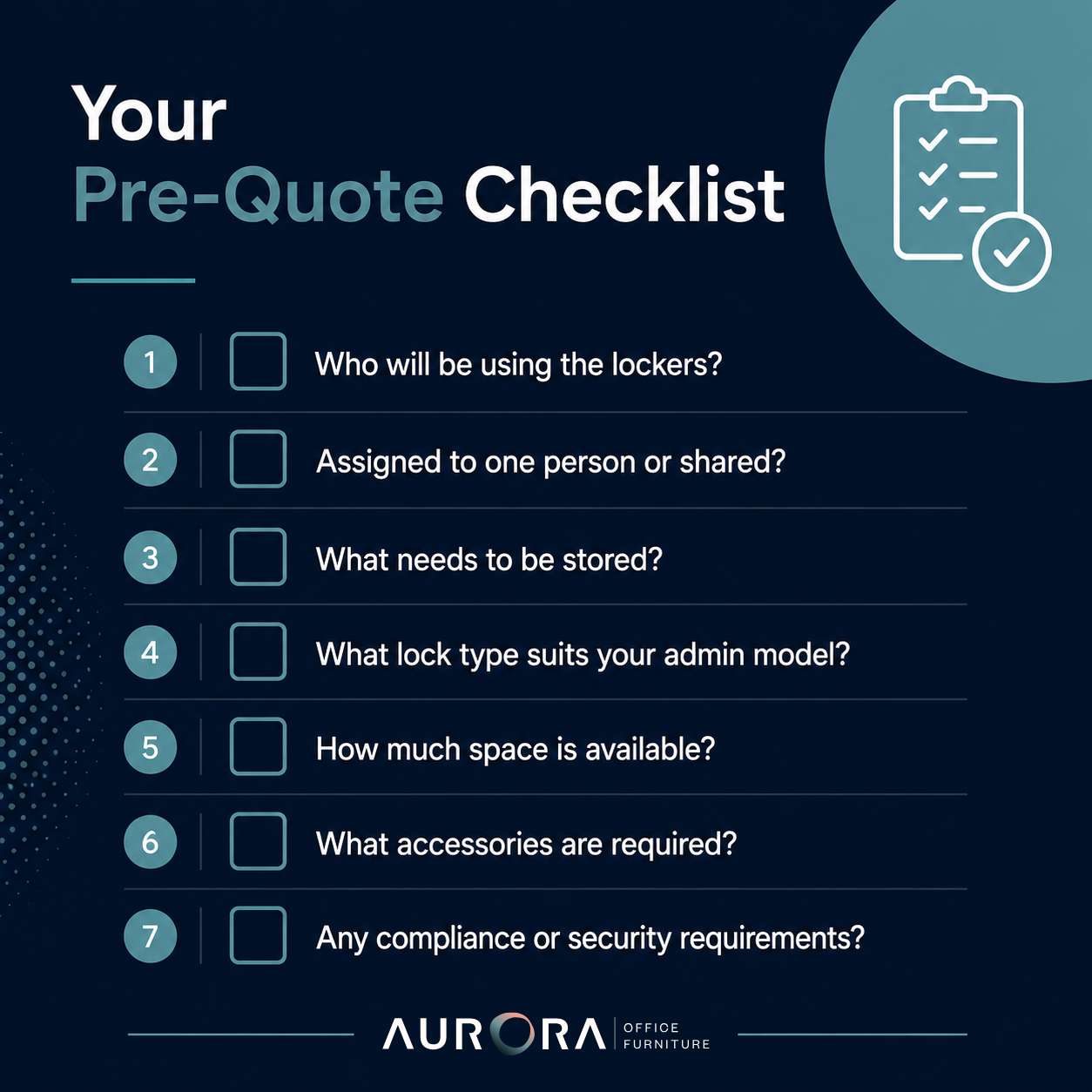
Getting these answers takes a short conversation. What it produces is a specification that works — not just a product list that fits a budget.
Working With Aurora Office Furniture on Your Locker Specification
Aurora Office Furniture supplies and installs commercial lockers for government, education and corporate environments across Canberra, Sydney, Melbourne and nationally. Our team works with facilities managers and procurement officers from initial brief through to installation, with a detailed specification and quote process that surfaces the issues before they become post-installation problems.
If you’re planning a locker purchase — whether for a small team or a large facility — contact Aurora to discuss your requirements and receive a detailed specification and quote.
“Asking the right questions upfront is the key to delivering a locker solution that remains efficient and easy to manage long term.”
Dean, Managing Director – Aurora Office Furniture
Browse Workplace Lockers


Commercial locker specialists — Canberra & nationally
Get a locker specification — not just a quote
Aurora works with facilities managers and procurement officers across government, education and commercial environments to specify and supply the right locker solution. We ask the right questions before anything is ordered — so installation day is straightforward and the lockers keep working long term.
Featured posts
View all posts




Get Our Pricing Catalogue
