


How To Choose The Right Type of Office Locker for Your Workplace
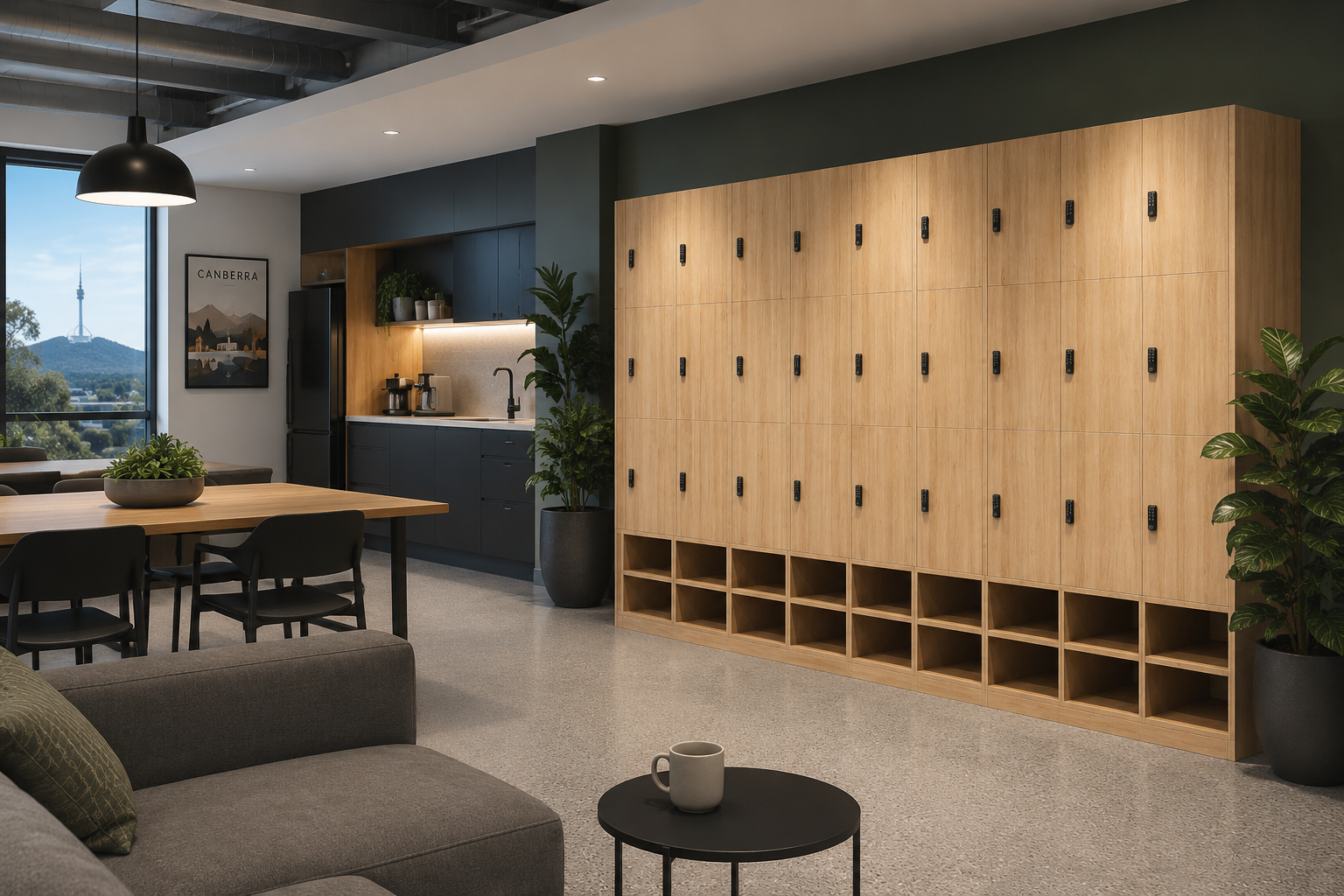
Get Pricing
Sit-stand desks, lockers, workstations and seating — indicative pricing for commercial fitouts in Canberra.
Pricing Catalogue
Aurora has supplied lockers across government, education and commercial environments — here’s how to match locker type to use case.
Quick answer
The right office locker depends on who’s using it, how often, and in what environment — not on price. Metal suits high-use and high-humidity environments. Melamine suits professional offices and hybrid workplaces. The locking system matters as much as the material.
After 20+ years supplying lockers to government, education and commercial environments across Australia, Aurora’s recommendation is always the same: start with the users, not the product.
Jump Ahead
Choosing the wrong office locker is more common than most buyers expect — and the consequences go well beyond aesthetics. We regularly see customers invest in lockers that look fine in a brochure but fail within months of installation: doors that warp in humid end-of-trip facilities, locking systems that create administration headaches for facilities managers, or storage configurations that simply don’t fit what staff actually need to store their personal items.
After more than 20 years supplying lockers across government, education, corporate and commercial environments, we have developed a clear methodology for matching locker type to use case.
We put together this guide to walk you through the key decisions — material, configuration, locking system and application — so you can buy with confidence.
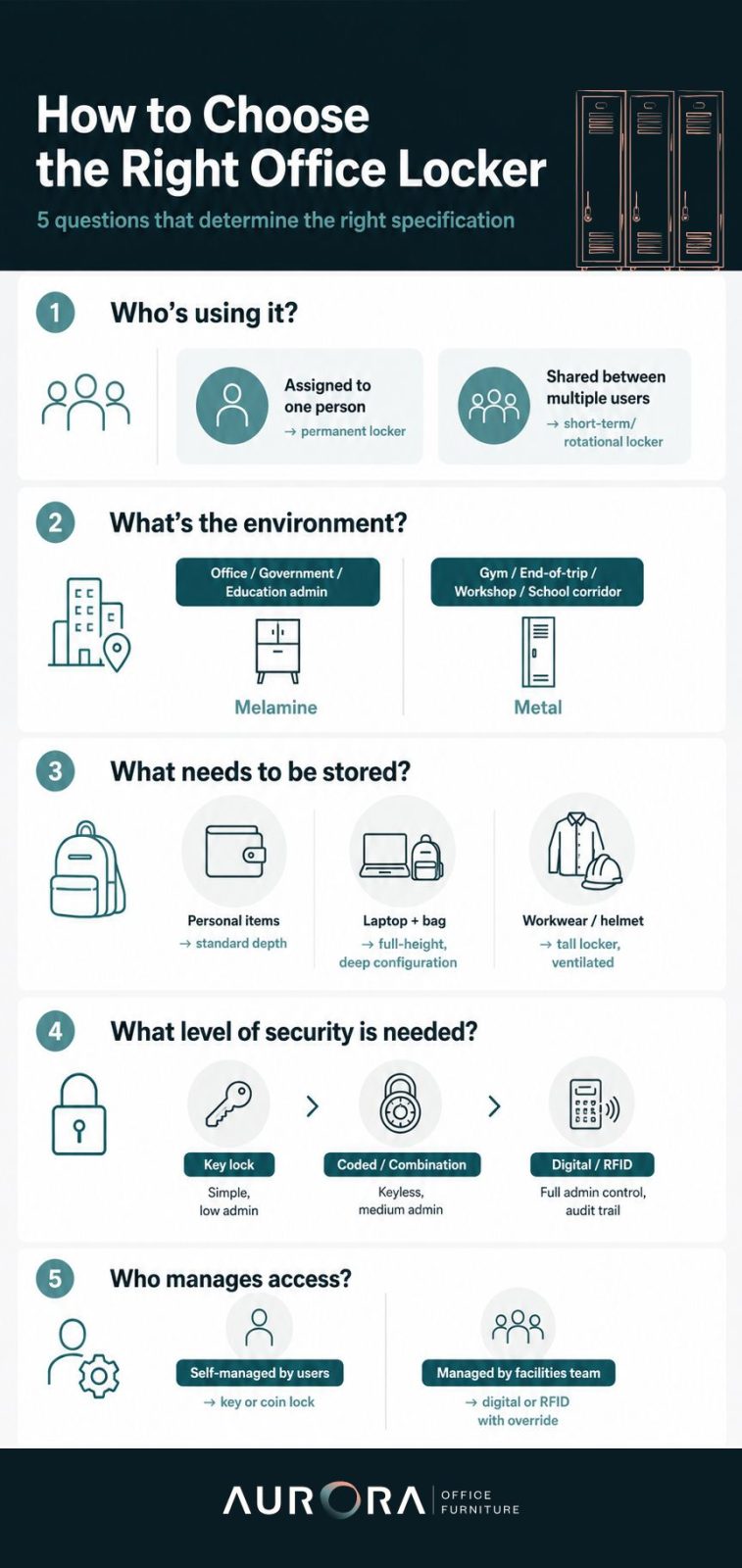
Start Here: The Questions That Actually Matter
Most buyers arrive with a size and a budget. The first thing our team does is step back and ask a different set of questions — because the right locker isn’t about dimensions, it’s about how the locker will actually be used day to day.
The questions that guide every locker specification:
- Who will be using the lockers — permanent staff with assigned units, or multiple people sharing on rotation?
- How frequently will they be accessed — daily, several times a day, or occasionally?
- What needs to be stored — personal items, laptops, workwear, helmets, valuables?
- What is the security requirement — basic deterrent, keyed access, or digital administration with audit trails?
- Who manages access, and how — facilities manager, HR, or self-administered by users?
- What is the environment — professional office, school corridor, gym changeroom, end-of-trip facility?
The answers to these questions determine material, configuration and locking system. Getting them right upfront is how you avoid the costly mistakes we see when buyers skip this step.
Metal vs Melamine: How to Make the Right Call
Material choice is one of the most debated decisions in locker procurement, and it’s also one of the most misunderstood. The short answer: the right material depends entirely on the environment, not on price point or personal preference.
| Melamine | Metal | |
|---|---|---|
| Best for | Corporate offices, government, hybrid workplaces, education admin | Gyms, end-of-trip facilities, school corridors, workshops |
| Appearance | Contemporary, office-grade finish | Utilitarian, industrial |
| Durability | Excellent in office environments; dent-resistant surface | Excellent in high-impact, high-humidity environments |
| Humidity resistance | Not suited to wet or high-humidity areas | Suitable with ventilation options |
| Colour options | Broad range, integrates with fitout palettes | Powder-coated, standard colour range |
| Locking options | Key, coded, digital, RFID | Key, padlock, coin-operated, coded |
Metal Lockers
Metal lockers are the right specification when the environment demands durability above all else. End-of-trip facilities, trade workshops, gymnasiums, school changerooms and high-traffic public areas are all environments where metal outperforms melamine over the long term.
Metal handles impact, humidity and heavy use in ways that melamine simply cannot. The trade-off is aesthetics — metal has a more utilitarian appearance that suits some environments better than others.
Best for:
- End-of-trip facilities
- Gyms
- School changerooms
- Trade or workshop environments
- High-traffic public areas
Advantages:
- Impact resistance
- Durability in harsh conditions
- Ventilation options
Limitations:
- More industrial appearance
- Heavier
- Can show surface wear over time
Melamine Lockers
Melamine is the dominant choice for professional office environments, and for good reason. The surface finish is clean and contemporary, it resists denting from incidental contact, and it holds its appearance over years of regular use. Melamine lockers sit comfortably within modern fitouts without looking industrial.
For hybrid and hot-desking workplaces specifically, melamine has become the default specification. The combination of professional aesthetics and ease of administration — particularly when paired with digital or coded locking — makes it the natural fit for modern commercial offices.
Best for:
- Corporate offices
- Government workplaces
- Education administration areas
- Hybrid workplaces
Advantages:
- Contemporary appearance
- Dent resistance
- Broad colour range
- Easy to keep clean
Limitations:
- Not suited to high-humidity environments or heavy industrial use
“Choosing the right locker for the environment is far more important than choosing one material over another.”
Aurora Office Furniture
Locker Types by Environment
The same locker specification that works perfectly in a government agency will cause problems in a school corridor or a gym changeroom. Here is how Aurora approaches each major environment.
Corporate and Government Offices
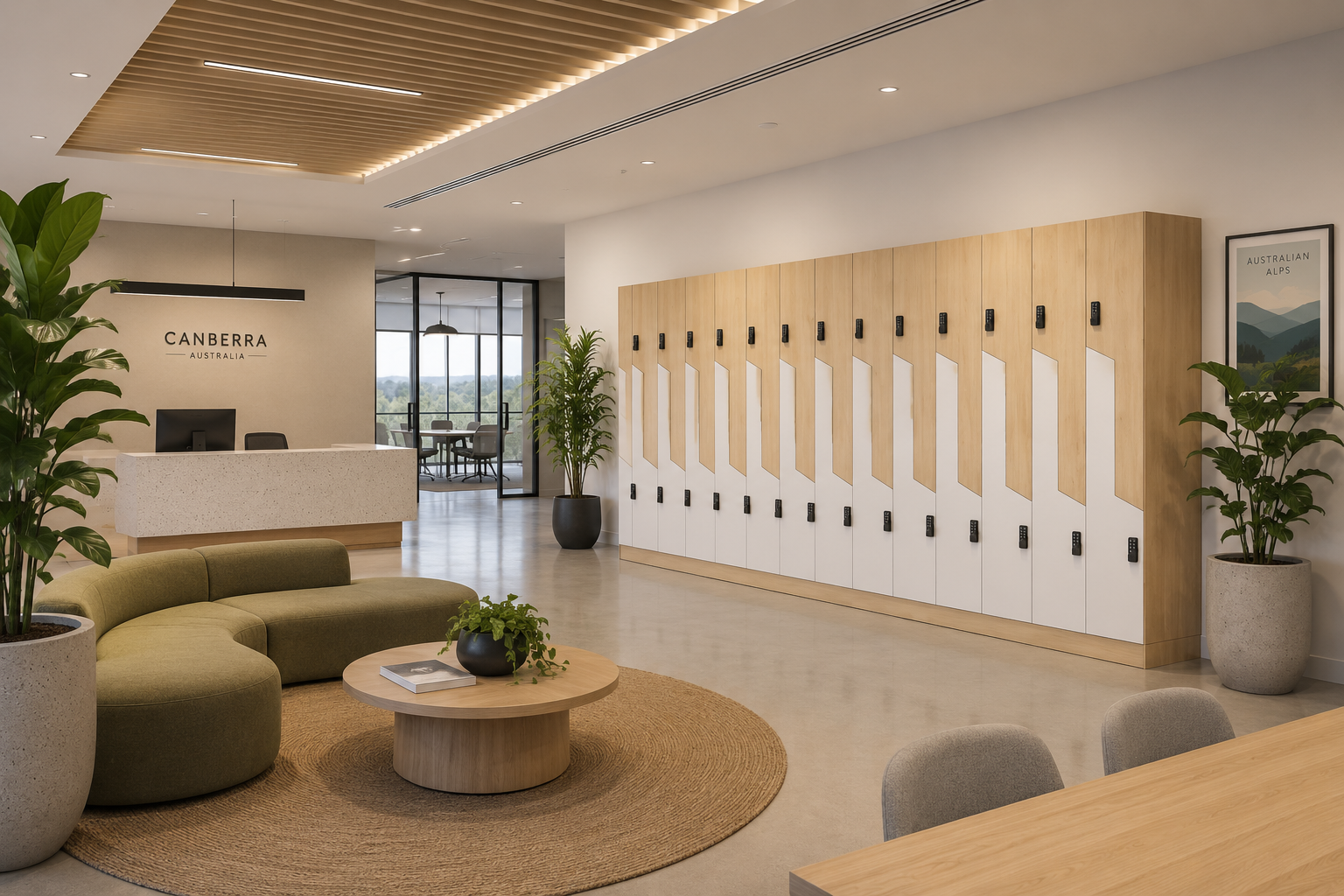
Government and corporate buyers consistently prioritise security, compliance and long-term administration. Lockers in these environments are typically used for personal belongings, mobile devices and in some cases laptops — often within secure areas or hot-desking floors where staff do not have a fixed desk.
The specification we see most often in government environments combines melamine construction with digital or RFID locking, giving facilities managers centralised access control and audit capability. This is particularly relevant in high-security agencies where access needs to be logged and managed at an administrative level.
Key considerations:
- Compliance requirements
- Lock management workflow
- Storage capacity for devices
Recommended:
- Melamine lockers
- Digital or RFID locking
- Administrative override capability
Hybrid and Hot-Desking Workplaces
Hybrid work has made personal lockers standard infrastructure in modern offices. When staff no longer have a fixed desk, a personal locker becomes their anchor point — the place their belongings live even if their desk location changes daily.
The most commonly requested configuration for hybrid environments right now is a personal locker assigned to each staff member, paired with a coded, digital or RFID locking system. This gives employees security and flexibility without requiring a fixed workstation.
Melamine is the clear material preference in these environments. The professional appearance integrates well with contemporary fitouts, and the administration features of digital locking align with the way modern facilities teams operate.
Recommended:
- Assigned personal lockers
- Melamine construction
- Digital or coded locking
Key considerations:
- Number of staff vs locker count
- Lock administration workflow
- Integration with access control systems
Schools and Education Environments
Education locker specifications vary significantly between the public and private sectors, and between administration areas and student-facing corridors. Office and administration areas in schools — the environment Aurora focuses on — typically call for a specification closer to corporate than to school corridor.
For student-facing areas and common spaces, durability and ease of management are the dominant requirements. Lockers need to withstand frequent use by a large number of different users, be straightforward to administer, and provide adequate ventilation. Key locks or padlock-compatible systems are common in school environments because they minimise ongoing administration burden.
Recommended:
- Metal construction for student-facing areas
- Melamine for administration and staff rooms
Key considerations:
- Volume of users
- Ease of access management
- Ventilation requirements
- Budget constraints
End-of-Trip and Gym Facilities
End-of-trip facilities present a specific challenge: high humidity, high turnover, and users who are managing wet clothing, helmets and cycling gear. Metal is almost always the right specification here — the durability and ventilation options it provides are not matched by melamine in this environment.
Gym and changeroom environments share similar requirements. The locking system in these settings needs to be simple and self-managed — users access and release their locker without needing administrator intervention. Coin-operated, key lock or basic coded systems suit this use case well.
Recommended:
- Metal construction
- Ventilated doors
- Self-managed locking (coin-operated, key lock or basic coded)
Key considerations:
- Humidity resistance
- Turnover frequency
- Ventilation
- Simplicity of user access
At a glance: locker specification by environment
| Environment | Material | Locking system | Key driver |
|---|---|---|---|
| Corporate / Government | Melamine | Digital / RFID | Security, compliance, admin control |
| Hybrid / Hot-desking | Melamine | Coded / Digital / RFID | Flexibility, professional appearance |
| Education — admin | Melamine | Key / Coded | Appearance, ease of purchase |
| Education — student | Metal | Key / Padlock | Durability, volume management |
| End-of-trip / Gym | Metal (ventilated) | Coin / Key / Basic coded | Humidity resistance, self-service |
| Workshop / Trade | Metal | Key / Padlock | Impact resistance, low maintenance |
Which Locking System Should I Choose For My Office Lockers?
Lock choice has a bigger impact on day-to-day operations than most buyers anticipate. The right locking system isn’t just about security — it determines who manages access, how much administrative burden falls on facilities teams, and how users experience the locker every time they interact with it.
A common mistake is treating lock selection as an afterthought: ‘I’ll sort it later.’ By the time the lockers are installed, the operational implications of a poorly chosen locking system become immediately apparent.
Key Locks
Key locks are the simplest, lowest-cost option and remain appropriate for environments where users are permanently assigned a locker and administration is minimal. The main operational risk is lost keys — each key loss requires a lock change, which in a large installation adds up quickly.
Best for:
- Permanently assigned lockers with stable user groups
- Lower-administration environments
Limitation:
- Lost key management
- No audit trail
- No remote access override
Coded (Combination) Locks
Coded locks eliminate the lost-key problem and suit environments where users need flexibility without full digital administration. Basic combination locks are user-managed; more advanced coded systems include master code overrides for facilities teams.
Best for:
- Hybrid workplaces
- Medium-administration environments
- Users who prefer keyless access
Limitation:
- Code sharing can undermine security
- Basic models offer no audit capability
Digital and RFID Locks
Digital and RFID locks are the specification of choice for corporate, government and high-administration environments. They provide centralised access control, administrative override, and in many cases full audit trails of who accessed which locker and when. RFID systems can integrate with building access cards, simplifying the user experience significantly.
The administration upside is considerable — facilities managers can reset, reassign or lock out users without needing to be physically present at the locker. For large installations or environments where staff turnover is frequent, this capability pays for itself quickly.
Best for:
- Government
- Corporate
- Hybrid workplaces
- Large installations
- High-security environments
Limitation:
- Higher upfront cost
- Requires ongoing software or system management
Padlock-Compatible Hasp
Some locker configurations are supplied hasp-ready, allowing buyers to use their own padlocks. This suits environments where the buyer wants flexibility to choose their own lock specification — schools, trade environments and temporary storage applications are common examples.
Best for:
- Schools
- Temporary storage
- Environments with existing padlock management systems
Read our full buyers guide on choosing the best locker lock type for your application.
What’s the Most Common Mistake Customers Make When Buying Office Lockers?
After more than 20 years of locker projects across government, education and commercial environments, these are the mistakes Aurora’s team sees most often:
- Buying on price without considering the total cost of ownership.
Cheap lockers fail faster in demanding environments. The replacement and reinstallation cost typically exceeds the saving within two to three years.
- Choosing the locking system last.
Lock selection determines operational workflow. Buying lockers without a clear lock strategy creates administration problems that cannot always be solved after installation.
- Underestimating storage capacity.
A locker that cannot fit a laptop bag, helmet or change of clothes is not fit for purpose. Think through what your staff actually need to store before specifying dimensions.
- Specifying metal lockers in professional office environments.
Metal is durable, but it looks industrial. In a corporate fitout, this is a visible mismatch that affects how the space presents to clients and staff.
- Specifying melamine in high-humidity environments.
End-of-trip facilities and changerooms expose lockers to consistent moisture. Melamine is not designed for this and will show damage quickly. Metal is the correct specification.
Get The Specs Right To Avoid Wasting Money
“The best office locker solutions start with understanding the users, the space, and the operational requirements — before selecting the configuration, materials, and locking system.”
— Aurora Office Furniture Sales Team
Getting the Specification Right From the Start
The consistent theme across every locker project Aurora Office Furniture has delivered is that the best outcomes come from a thorough needs analysis before any product is selected. Material, configuration, locking system and layout should all follow from a clear understanding of users, environment and operational requirements — not the other way around.
Aurora’s team works with facilities managers, procurement officers, interior designers and project managers across Canberra and nationally to specify and supply locker solutions for commercial, government and education environments. If you have a project in mind, our team can help you work through the specification questions and provide a detailed quote.
Frequently Asked Questions
Metal lockers are best for high-use, high-humidity or heavy-impact environments — gyms, end-of-trip facilities, school corridors and workshops. Melamine lockers are the preferred choice for professional office environments: they offer a more refined appearance, resist denting, and hold their presentation over years of use. In our experience, choosing the right locker for the environment matters more than the material itself.
The most commonly requested configuration is a personal locker assigned to each staff member, paired with a digital, coded or RFID locking system. Melamine construction is the clear preference — it integrates with modern fitouts and is straightforward to administer.
For most modern office environments, digital or coded locks are the better choice. They eliminate the lost-key problem, give facilities managers administrative override capability, and RFID versions can integrate with existing building access systems. Key locks remain appropriate for permanently assigned lockers with stable user groups where administration is minimal.
Government offices generally prioritise security, compliance and centralised access management. The typical specification is melamine construction with digital or RFID locking, providing administrative override and audit trail capability. Aurora has extensive experience supplying to Canberra-based government agencies.
Yes. Power-integrated lockers are available for environments where device charging is a requirement — useful where staff store and charge laptops, tablets or phones. This is increasingly common in government and corporate environments where secure device storage is part of the brief.
Contact Aurora’s team with details about your environment, number of users, storage requirements and any lock preferences. We supply and install locker solutions across Canberra, Sydney, Melbourne and nationally for commercial, government and education clients.
Recommended Products


Commercial locker specialists — Canberra & nationally
Ready to specify your locker solution?
Aurora’s team works with facilities managers, procurement officers and interior designers to specify and supply the right locker solution for any environment. Government, education and commercial — Canberra to nationally.
Featured posts
View all posts




Get Our Pricing Catalogue
