


Pros & Cons of Melamine vs Metal Lockers

Get Pricing
Sit-stand desks, lockers, workstations and seating — indicative pricing for commercial fitouts in Canberra.
Pricing Catalogue
Quick Answer
Melamine vs metal lockers — which is better?
Neither material is categorically superior. Both deliver reliable long-term performance in the right environment. The specification decision should be driven by the level of use, user behaviour, security requirements, and aesthetic fit — not material assumptions or upfront price. A commercial-grade melamine locker in a corporate office will typically outlast a budget metal locker in the same environment.
When our customers compare melamine and metal lockers, the conversation usually starts with price. It rarely starts with the right question — which material is correct for our specific environment and end users?
That distinction matters more than most customers realise. After more than 30 years of supplying and installing commercial lockers across government departments, schools, corporate offices and end-of-trip facilities, Aurora Office Furniture’s team has seen what happens when the wrong material is specified — and what long-term performance actually looks like when the specification is right.
We’ve laid out the real pros and cons of both materials, the environments where each performs best, and the questions you should be asking before any locker order is placed.
The Short Answer: It’s About the Environment, Not the Material
Neither metal nor melamine is categorically superior. Both can deliver excellent, long-term performance in the right application. Both can fail prematurely in the wrong one.
“In a typical commercial environment, there is often very little difference in lifespan between a quality metal locker and a well-designed melamine locker when each is used in the right application. The real factor affecting longevity is not the material itself, but whether the locker has been correctly specified for the environment and users. After more than 20 years of experience, we’ve found that choosing the right locker for the application is far more important than focusing solely on the material.”
Dean — Managing Director, Aurora Office Furniture
The starting point for any locker specification should be an honest assessment of the environment: how many users, how frequently will lockers be accessed, what level of physical use is realistic, and what security requirements apply.
Comparison At A Glance
Metal vs melamine lockers — specification comparison
| Factor | Melamine | Metal (Steel) |
|---|---|---|
| Durability in standard commercial use | Excellent when correctly specified | Excellent when correctly specified |
| Impact resistance | Moderate — reinforce with steel-framed front in high-use settings | High — suited to heavy-use environments |
| Finish & colour options | Wide laminate range — easily matched to joinery | Powder-coat range more limited |
| Cosmetic wear over time | Resists surface denting and chipping | Dents and chips visible — affects long-term presentation |
| Moisture resistance | Avoid prolonged wet exposure | Corrosion risk without protective coating |
| Best environments | Corporate offices, government, healthcare admin, end-of-trip | High-traffic, high-impact, industrial, outdoor/semi-outdoor |
| Upfront cost | Varies — commercial-grade is mid-range | Varies — heavy-duty steel carries a premium |
Melamine Lockers: Where They Work and Where They Don’t
Melamine lockers are manufactured from high-density particleboard or MDF with a melamine laminate surface. In most commercial office environments — corporate fitouts, government workplaces, healthcare administration areas — they provide excellent durability, a clean aesthetic, and a wide range of finish and colour options.
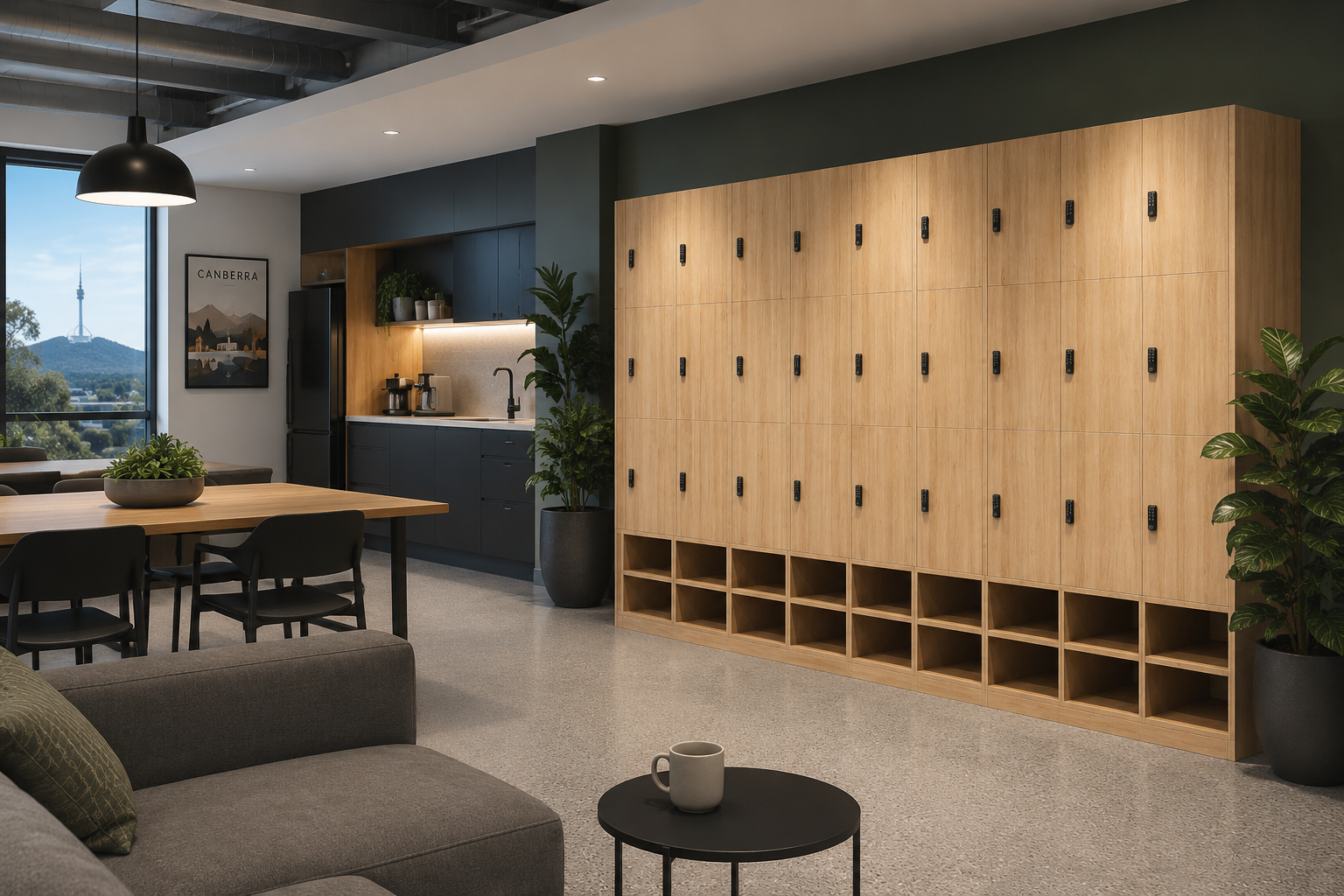
The material lends itself naturally to modern interior specifications. Melamine lockers can be colour-matched to joinery, specified in a broad range of finishes, and integrated into fitouts where visual consistency matters.
Where melamine performs well:
- Corporate offices and government workplaces with moderate daily use
- Healthcare administration and staff areas
- Education administration and staff rooms (not high-traffic student areas)
- End-of-trip facilities in commercial buildings
- Environments where aesthetics and finish options are a specification priority
Where melamine has limitations:
- High-impact environments such as school student areas or facilities with heavy daily abuse
- Settings where lockers are likely to be subjected to repeated force or vandalism
- End-of-trip facilities with very high user volumes and frequent cycling
In demanding environments, the solution is not necessarily to switch to metal — it is to specify melamine lockers with additional structural reinforcement.
“In the right environment, quality melamine lockers rarely fail. The challenges typically arise in exceptionally high-use or high-impact environments, such as schools or other settings where lockers are subjected to significant abuse. In these situations, we often recommend melamine lockers with a steel-framed front and full-length piano hinges, which provide exceptional strength and help maintain the integrity of the doors over the long term. The key is matching the locker construction to the demands of the environment rather than assuming one solution suits every application.”
Dean — Managing Director, Aurora Office Furniture
Metal Lockers: Durability, Limitations and Common Assumptions
Metal lockers — typically constructed from cold-rolled steel with a powder-coat finish — are the default assumption for high-durability applications. In many cases this is justified. In others, it reflects a habit of specification rather than a considered assessment.
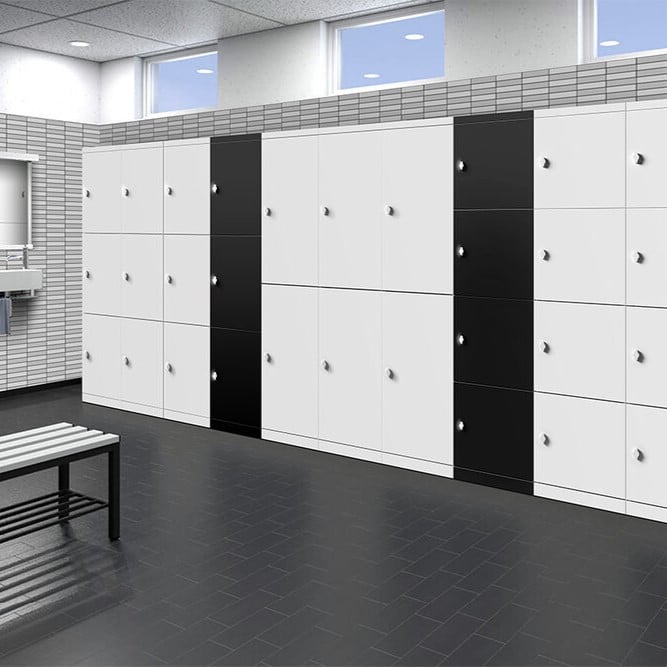
Where metal lockers perform well:
- High-traffic environments with frequent, heavy daily use
- Applications requiring maximum impact resistance
- Outdoor or semi-outdoor installations
- Environments where security is the primary specification driver
- Industrial or warehouse settings where aesthetics are secondary
Where metal lockers have limitations:
- Environments where dents, chips or surface damage will affect presentation — metal shows cosmetic wear that melamine does not
- Fitouts where finish options and colour matching are important — metal powder-coat ranges are more limited than melamine laminate options
- Humid or wet environments without appropriate protective coatings — standard steel lockers can corrode
“We are generally cautious about specifying standard metal lockers in environments where lockers are likely to be subjected to heavy abuse or impact, such as some schools or correctional facilities. In these settings, dents, bending, and cosmetic damage can occur over time, affecting both appearance and longevity. After more than 20 years of experience, we’ve found that selecting a locker specifically designed for the expected level of use is far more important than choosing a material based on assumptions alone.”
Dean — Managing Director, Aurora Office Furniture
The Cost Conversation: Upfront Price vs Total Cost of Ownership
The most common driver of poor locker specification decisions is a focus on upfront unit cost. Buyers who compare two lockers on purchase price alone frequently miss the more significant cost variables: maintenance requirements, lock replacement, early replacement cycles, and the ongoing impact on workplace presentation.
“Rather than focusing solely on the upfront cost, we encourage buyers to consider the total cost of ownership over the next five years. A higher-quality locker solution may carry a premium initially, but it can significantly reduce maintenance, lock administration, replacements, and user frustrations over time. The key question is whether the solution will still meet operational needs and present well years down the track. In our experience, the right locker is not necessarily the cheapest option — it’s the one that delivers the best long-term value for the specific environment and users.”
Dean — Managing Director, Aurora Office Furniture
We regularly see organisations return after purchasing low-cost lockers that initially appeared to offer good value. The most common issue is that budget lockers often show signs of wear, damage, and deterioration much sooner than expected, particularly in busy commercial environments. The trigger for replacement is usually the realisation that the initial saving has been outweighed by reduced durability, a poorer user experience, and the need to replace the lockers far sooner than anticipated.
After more than 30 years in the industry, we’ve found that investing in a commercial-grade solution typically delivers far better long-term value.
What Warranty Coverage Actually Tells You
Warranty terms are a useful reference point, but they do not tell the whole story. A warranty does not compensate for a poor specification decision — it only provides a remedy when a correctly specified product fails under normal use.
Warranty differences can provide some reassurance, but they don’t tell the full story about whether a locker is the right choice for your environment. The real issue arises when a locker is used in an environment it wasn’t designed for. Warranty coverage won’t compensate for a poor specification decision. That’s why the most important factor is working with experienced specialists who can assess your requirements and recommend a fit-for-purpose solution that will perform reliably for years to come.
When reviewing warranty terms, the relevant question is not just the length of coverage — it is what the warranty covers, what voids it, and whether the supplier has the operational depth to support a claim over the warranty period.
How to Specify the Right Locker Material
These questions determine the material and construction requirements. The material decision follows from the answers — not the other way around.
Before specifying locker material — six questions to answer first
- How many users will access the lockers daily, and how frequently?
- What is the realistic level of physical use — light office access, or high-volume cycling in a school or gym facility?
- Is impact resistance or cosmetic presentation the higher priority for this environment?
- What are the security requirements — key lock, digital lock, or shared-access systems?
- Does the finish need to match existing joinery or a specified interior palette?
- What is the expected service life, and what does total cost of ownership look like over that period?
How We Approach Locker Specification
Our approach to choosing between melamine and metal lockers begins with a needs analysis that covers the environment, the users, the frequency of use, the security requirements, and the aesthetic requirements of the fitout. Product selection follows from that assessment.
This process is the reason our clients do not face early replacement cycles or ongoing maintenance problems — and why organisations that have purchased budget lockers elsewhere consistently return to us when those products fail to perform.
If you are in the process of specifying lockers for a new fitout, refurbishment, or replacement project, contact Aurora Office Furnitures team for a detailed assessment and quote.
Aurora Office Furniture — Canberra
Specifying lockers for a fitout or refurbishment?
Aurora’s team provides a detailed needs analysis before any locker is specified — covering environment, user volume, security, finish requirements and total cost of ownership. Get the specification right from the start.
Browse Melamine & Metal Lockers


Featured posts
View all posts




Get Our Pricing Catalogue
